
鋼琴小品:Skipping Stones, Both of Us
秋分時節的某個早晨,只見一對伴侶在微弱日光的映照下,於一個靜謐的河畔中隨心漫步。那河畔的地面鋪滿了鵝卵石,週邊也被楓樹包圍着,一片片緋紅色的楓葉也正隨着微風飄拂。
過了一陣子,其中一位心血來潮,決定撿起一塊鵝卵石,二話不說地將之往河中一扔,玩起了打水漂。另一位見狀,也開始產生興趣,同樣撿起了鵝卵石加入。
於是,他們開始輪流地將鵝卵石拋到河中,嘗試着讓它打水漂。雖然不是每次都成功,但他們在互相嬉鬧的過程中玩得很高興。透過那時不時的眼神交會,他們之間的關係彷彿更拉近了一些。
就這樣,我以上面的背景故事作爲發想的出發點,寫了一首篇幅相對短的鋼琴小品:Skipping Stones, Both of Us。
厚臉皮地自我行銷一下:想購買鋼琴譜表示支持的,可以前往這個連結哦!感謝。
煙霾空污被颱風向外擴散
在一篇我到現在都沒開始動手寫的某動漫展遊記文章中,我是想要在裡頭順便寫一段對目前已糾纏馬來西亞(以及其他東南亞多國)許久的印尼跨境煙霾的小抱怨,吐一下「自己因爲煙霾而搞得長時間出門時都得戴口罩」的苦水。
那篇文章我到現在都沒寫好(尷尬笑),不過剛才我倒是偶然得知這個我完全沒想過會真實發生的事。
像這樣的大型煙霾已經斷斷續續地困擾了東南亞地區長達幾十年(呃),而這場煙霾也是特別嚴重的一次,已經持續了快要三個月仍不得緩解。
該說是雪上加霜嗎?好巧不巧,近日颱風薔琵襲捲,不僅使得臺灣多地停班停課,而且也⋯⋯似乎將東南亞的部分煙霾空污帶到臺灣去了?!
這是什麼百年難得一見的「奇景」?
從巴生谷一帶乘搭 ETS 長途火車的建議上車站
這是給住在西馬巴生谷(英文:Klang Valley)一帶,並且想要搭乘 KTM 的 ETS 長途火車服務的人參考用的。
如果以 KL proper(正式的吉隆坡行政區)作爲參照點的話,若你的住處比較靠近以下三個區域之一,爲了節省另外搭乘列車(MRT、LRT)或公共巴士所需花費的額外時間,其對應的建議上車站如下:
- 🟨 北部:Rawang(萬撓)站、Sungai Buloh(雙溪毛糯)站、Kepong Sentral(甲洞中環)站
- 🟥 中部:KL Sentral(吉隆坡中環)站、Kuala Lumpur(吉隆坡)站
- 🟦 南部:Bandar Tasik Selatan/Bdr Tasek Selatan(南湖鎮)站、Kajang(加影)站
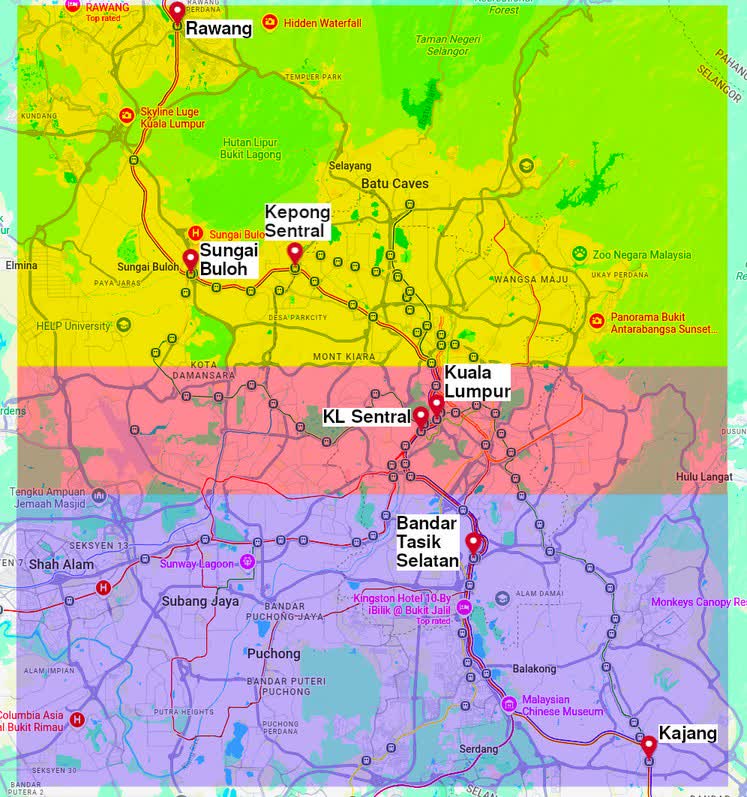
此外,也要特別注意車站是否有北上(至玻璃市或檳城)車次或是南下(至柔佛新山)車次停靠。
| 站名 | 北上? | 南下? |
|---|---|---|
| Rawang | ✅ | ✅ |
| Sungai Buloh | ️✅ | ️✅ |
| Kepong Sentral | ️最多只到 Ipoh(怡保) | 最多只到 KL Sentral |
| KL Sentral | ️✅ | ️✅ |
| Kuala Lumpur | ️✅ | ️✅ |
| Bandar Tasik Selatan | ️✅ | ️✅ |
| Kajang | ️✅ | ️✅ |
這是我個人在「走過冤枉路」(也就是花太多時間去到離住處較遠的車站)過後得出來的小貼士,除了給我自己 memo 用之外,也希望能夠幫助到其他人。
AI 生成文宣滿大街
此文章爲我先前寫的這篇英文文章的華文翻譯。
我讀到了這篇由 luke.zip 撰寫的(英文)文章,描述着在他居住地(即紐約)週邊越來越頻繁出現的 AI 生成文宣。
歐買尬,我對此真是深有同感,因爲這正是於馬來西亞大街小巷同樣在發生的事情啊!
⚠️ 傷眼注意:某馬來西亞餐廳在外展示 AI 生成文宣的實例圖。
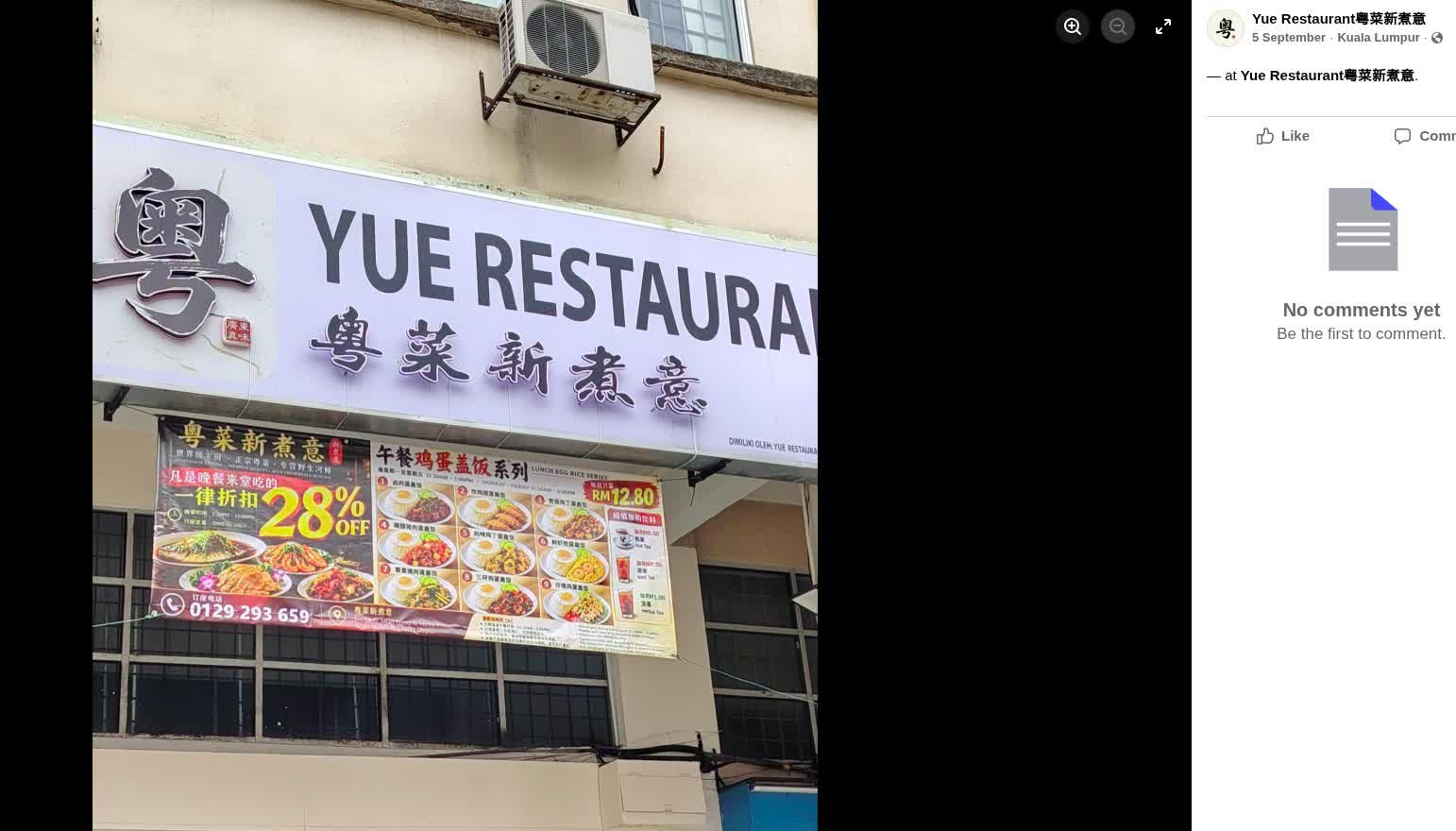
每次我遇見它們時,我對它們的反應和 luke.zip 的差不多:我的腦袋會立刻關機,或者直接將之略過。
有句俗話說:「你就是你吃下的東西」。我對此表示高度認同,因此我會自發地管理我在網上吸收的資訊。
不過咧,如果我在真實世界中大都是被這些毫無靈魂的醜物包圍(而且幾乎躲也躲不了),我是要怎樣將這個原則繼續維持下去呢?
搞成這樣,還想說要營造一個培養好品味的環境?諷刺的是,「好品味」卻恰恰是那些「AI 迷」常愛掛在嘴邊的所謂「人類優勢」。
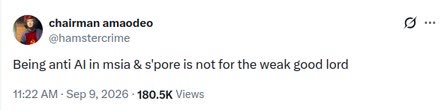
延伸閱讀:
Google Maps 停靠點功能的一個煩人之處
在 Google Maps 上,有一個「新增停靠點」功能,可以讓使用者在規劃路線時,在起始地與最終目的地之間加入幾個1中繼站點,方便使用者找出一條途經多個指定地點的路線。這個功能從 2016 年開始便已存在。
舉個例子,若在一場聚會後,想要在駕車回自己住處之前順便接送幾個朋友回到他們各自的住所,便可以使用此功能:只需一鍵按下 Add destination(新增目的地)——或是在手機的話就是 Edit stops(編輯停靠站)——即可。
另一個例子:我想要搭列車前往某個知名地標,但也許是出於轉乘次數較少、步行路線較順暢等因素,我想在某個特定的週邊車站下車(而非 Google 建議的),並從該車站走路到目的地。這時候,我可以使用這個「新增停靠點」功能,將該車站設定爲中繼站點之一⋯⋯
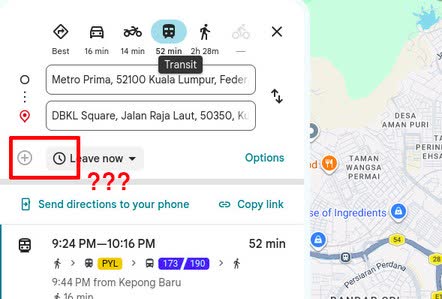
咦?怎麼回事?那個最重要的按鍵呢?
哦,原來是 Google Maps 壓根就不支援在公共交通模式中使用「新增停靠點」功能啊。
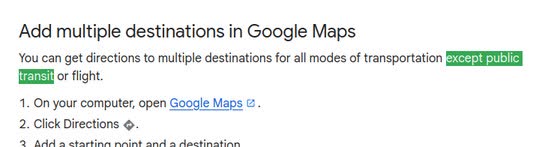
截圖取自 Google 的官方說明網頁。
哇嗚,Google 在這方面真的彷彿是在跟(對解決塞車問題作出極大貢獻的)大衆運輸使用者說一句 Fuck you 呢。
延伸閱讀:
-
確切來說其實是最多八個(不算最終目的地的話)。這也是另一個煩人之處。 ↩︎
有髒東西跑進我的 Android 手機了
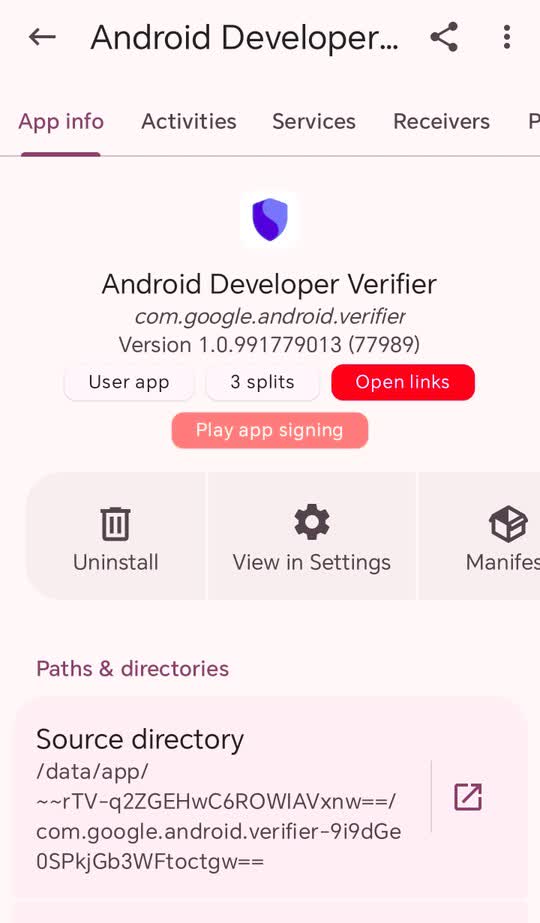
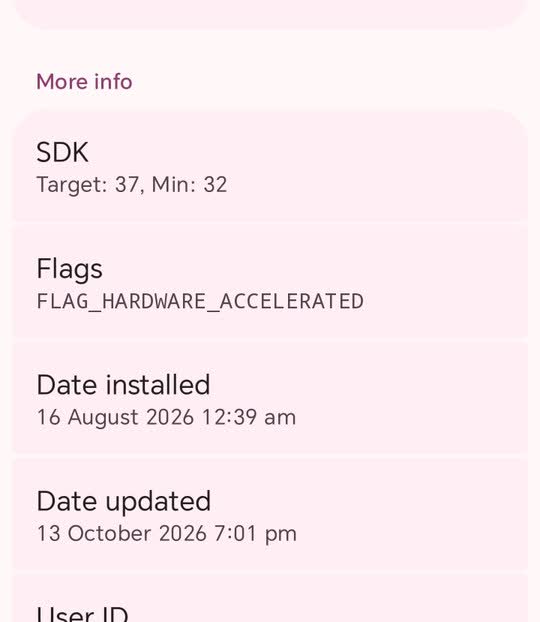
如下圖所示,它是在今年 8 月(也就是兩個月前)被自動安裝進我的手機裡頭的,完全沒有通知。
風扇困難死?
在一個由馬來西亞漫畫出版社 Gempak Starz(平方集團)1舉辦的某路跑活動的某宣傳單上,印有一句我之前見也沒見過、令我摸不着頭腦的馬來語用詞。

然後我思索了一陣子後,赫然茅塞頓開:「等一下,kipas 的英文是 fan,susah 的英文是 hard,mati 的英文是 die⋯⋯
⋯⋯所以 kipas-susah-mati 其實是英文短語『diehard fan』(死忠粉絲)的字面直譯?!」
⋯⋯哈??????XDDD
順手再上網爬了其他文章發現,原來這個馬來文俚語/流行語,Gempak Starz 本身早在 2005 年就已經有在用了?!據說它甚至就是由 Gempak Starz 自己帶紅(到馬來西亞的馬來語圈)的?!
哈??!??!🤣🤣🤣
順帶一提,我也找到了一篇(古早)馬來文 blog 文章,也是在講同樣的東西。啊,所以我在這方面並不孤單啊 LOL。Bukan saya saja yang ada kekeliruan ini, OK?
A confusing (auto-generated) email from Ko-fi
I’ve recently made a donation to an online artist via Ko-fi, which is a fundraising and content subscription service that is fairly popular within the artist community and known for its relatively low percentage rate (0-5%) of platform fees.
I don’t have a Ko-fi account, but fortunately, I am allowed to make the donation without having to create one. I can do that as a guest by entering my email address and payment method information.
After donating, I then received two emails from Ko-fi. One of them was the payment receipt, but the other one looked so peculiar to me that I was motivated to write this article.
Before I clicked into the email, its preview displayed a line of text that contained an inconsistent combination of promotional (marketing email sounding) and cautionary (security email sounding) tones.

When I opened the email to read its body text, I then found myself looking at a series of statements, with some of them seemingly contradicting each other (tone-wise, or in one example, literally), at least that’s what I think.
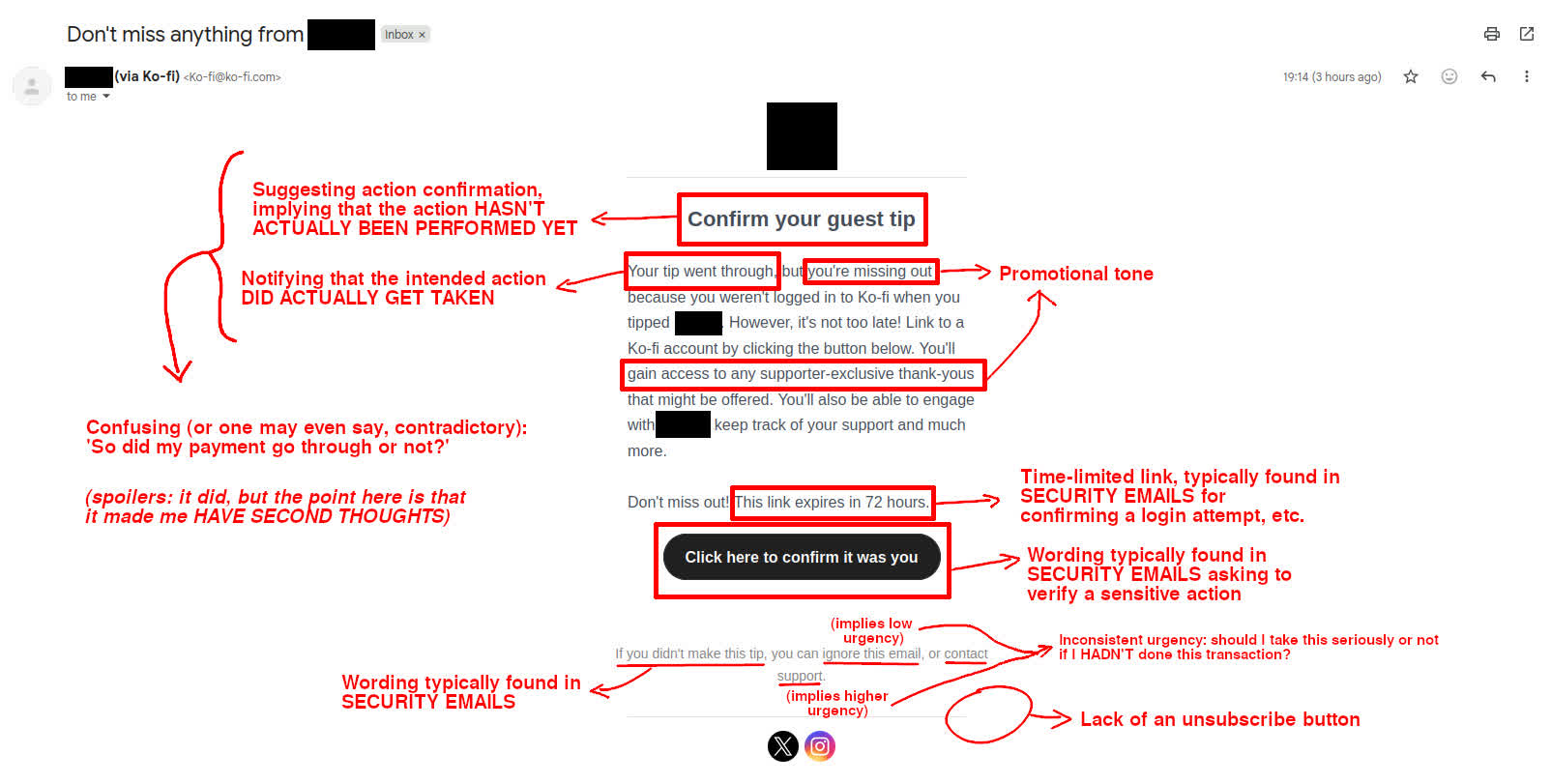
Besides a puzzling mix of marketing-email-like (‘you’re missing out’, ‘it’s not loo late’, etc.) and security-email-like (‘Confirm your guest tip’, ‘Click here to confirm it was you’) phrases, I think it’s a bit sinister that the more urgent-sounding security-email-styled phrases are featured the most prominently in the email body, with ‘Confirm your guest tip’ being the heading, and the ‘ominous’ ‘Click here to confirm it was you’ button being the hardest-to-ignore element inside the email.
The lack of an unsubscribe button is also really weird, because this is usually a feature of security emails that tells the recipient that they should (reasonably) pay more attention to the email, but this particular email is basically marketing in nature: it’s trying to promote a feature offered by the platform with almost no stakes involved on the end user’s side, as illustrated by the screenshot below, which shows the webpage that launches after clicking that big black button in that email.
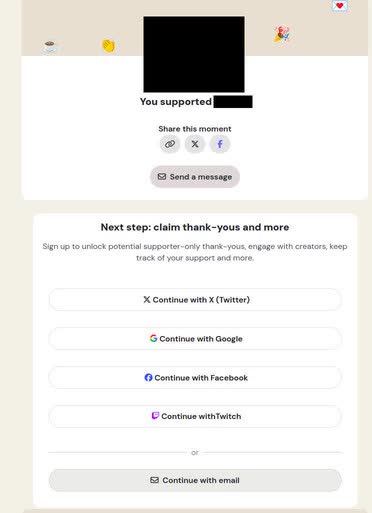
Unless… it’s trying to trick users into thinking that it’s a security email that deserves immediate attention, which is categorically not what’s actually happening here (or it’s simply one of those kinds of irritating marketing emails that cannot be easily opted out).
In my opinion, as a crowdfunding platform, Ko-fi’s business practice is already more consumer- and creator-friendly compared to its competitors, especially considering their low platform fee rates.
Still, I’d appreciate it if they were more direct, honest and transparent in communicating their intent of persuading people to sign up for an account in their platform, instead of employing trick wording in what looks like an attempt to disguise essentially a marketing message so that it resembles a security warning, thereby attracting an unwarranted amount of urgency.
Also, I’m pretty sure that when people make donations without an account, in most cases they’re consciously making this decision, i.e. they actively choose not to sign into or create an account. Thus, receiving an email afterwards that basically ‘reminds’ them to do the exact opposite of their preference, without even having the option to unsubscribe from it, is really annoying.
Alas, I expected better from you, Ko-fi.
Yes-man
When you try to minimise conflicts and/or the number of people you’re gonna offend…
When you try your best to find merits in both of the opposing sides in a (potentially controversial) discussion…
When you find things you agree with in both sides of the argument…
you can end up losing the ability to form opinions at all.
Isn’t that scary?
Accents ultimately don't mean a lot
One day when I went for my usual grocery shopping, I stumbled upon a child behind me when I was queuing up at a payment counter.
The little kid, who looked to be of Chinese ethnicity and about two to three years old, was riding a fairly small-size bicycle which was obtained from the supermarket and wasn’t yet paid for. And then for some reason, he repeatedly attempted to ride over me while (lightly) hitting one of my calves.
Slightly startled and annoyed by this laughable behaviour, I turned my head back and looked towards the child, who was still riding on the bicycle. To my surprise, he seemed to be even more annoyed than I was, and started to complain to his mother using words that vaguely sounded like English, while staring back at me.
To his mother’s credit, she did try to stop him and verbally reprimanded him using Mandarin. However, he didn’t show a sign of conceding and kept saying something like a complaint and looking at me angrily, while I continued to stare at him with a poker face.
Fortunately this didn’t last long. It was my turn to pay shortly after that, so I shifted my attention to making the payment, while the kid was stopped by his mother.
Well, this whole incident didn’t really bother me a lot, but what intrigued me the most was the child’s manner of speech when he was complaining. I could clearly register that his talking resembled English with a very noticeable American accent, yet other than the easily recognisable ‘mommy, mommy’, whatever else he said was essentially plain old gibberish.
I know I shouldn’t be too hard on a toddler, but this encounter reminds me of certain Malaysian parents who deliberately teach their children only English, even though it isn’t necessarily their mother tongue, and it has to be in American or British accent for some reason (mostly American though).
Granted, there is nothing wrong with the act of teaching a language or an accent itself; what rubs me the wrong way is their motivation behind this kind of parenting decision: they perceive this to be the ‘higher-class’ way of educating their children, for the sole reason of them… speaking English in a Caucasian-sounding accent.
Anyways, I digress. What did I learn from this incident then? Well, it’s that accents ultimately don’t mean a lot1, especially when it comes to one’s attitude and upbringing.