
G clef ≠ treble clef; F clef ≠ bass clef
This is a discussion about the appropriate (English-language) terminologies for clefs in sheet music.
In my opinion, a G clef is not the same thing as a treble clef, and F clef not a bass clef, even though many people and sources may suggest otherwise.
Contrary to the (common?) misconception that ‘G clef’ (resp. ‘F clef’) is the ‘en-US version’ of the ‘en-GB term’ ‘treble clef’ (resp. ‘bass clef’), it isn’t even a matter of en-GB vs. en-US, like ‘stave’ vs. ‘staff’, or ‘crotchet1’ vs. ‘quarter note’; they simply are not equal concepts.
Why so? This is because a ‘G clef’ (resp. ‘F clef’) is to be viewed independently, whereas a ‘treble clef’ (resp. ‘bass clef’) is context-dependent, i.e. its position on the 5-line stave should also be taken into account.
This also brings us to another interesting as well as important point that many experienced musicians may (understandably) still overlook: there exists other clefs that use the ‘G clef’ (resp. ‘F clef’) symbol, but are not a ‘treble clef’ (resp. ‘bass clef’), just like the case of an alto clef vs. a tenor clef, etc., both of which use the ‘C clef’ symbol.
I hope that the following graphics explain better than the paragraphs of plain text above.
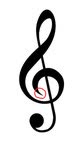
This is called a G clef. The tip in its centre (circled in red) indicates the position on which the G4 pitch is located.
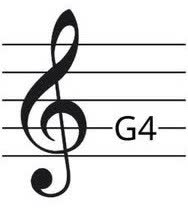
A G clef becomes a treble clef only when it is placed with the tip lying on the second line (counted from bottom to top) of the stave.
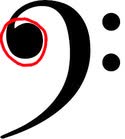
Similarly, this is called an F clef. Its tip on the left side (circled in red) indicates the position on which the F3 pitch is located.
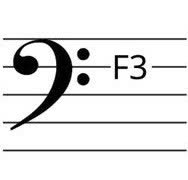
An F clef becomes a bass clef only when it is placed with the tip lying on the fourth line (counted from bottom to top) of the stave.

In fact, this also implies that the G clef and F clef can be placed at different positions of the 5-line stave and become different clefs. Here are the examples (circled in red; those using the ‘C clef’ symbol are included in the middle). Image edited from: Sakurambo, CC BY-SA 3.0, via Wikimedia Commons.

Theoretically, the G clef (resp. F clef) can be placed on any of the five lines of the stave, with that said line indicating where the G4 (resp. F3) pitch is located. However, at least as far as I’m aware of, there is no ‘official’ name for such other clefs not included in the figure above (e.g. the ‘2nd-line F clef’ or the ‘5th-line G clef’).
Anyway, hope this article gets the point across: G clef ≠ treble clef, and F clef ≠ bass clef!
Further reading:
- English Wikipedia article on clefs
- An article on clefs in Grove Music Online (requires paid/institutional access)